Ugritone Review: Essential Tools for Metal Music Production
Discover if Ugritone is right for your studio. Our review covers their VST plugins, MIDI packs, and drum samples designed for professional metal production.
Read Review ->Computers & Office Equipment
Our Host Havoc review explores game server performance, mod support, control panels, pricing, customer service, and what to know before hosting.
A multiplayer world is easy to fall in love with and surprisingly difficult to keep running. One evening, a few friends decide to build a Minecraft settlement, survive another brutal Rust wipe, or establish a permanent base in ARK. Before long, the server becomes more than a place to play. It holds hundreds of hours of progress, shared projects, custom rules, and memories that everyone expects to find exactly where they left them.
The trouble begins when the person hosting that world becomes responsible for everything behind it. A server stops responding after an update. A new mod creates unexpected errors. Players complain about lag, even though the internet connection seems fine. Suddenly, what started as a hobby feels like a second job.

This is where Host Havoc makes an interesting proposition. Rather than asking players to assemble and maintain their own hosting infrastructure, the company provides game-focused hosting services, management tools, and technical assistance designed to make running an online community more manageable.
But renting a server is not automatically the same as getting a better gaming experience. Hardware quality matters, yet so do configuration flexibility, geographic location, support responsiveness, and the ability to recover when something goes wrong. This Host Havoc review examines how these pieces fit together, what the service costs in practice, and which types of players are most likely to appreciate what it provides.
The biggest advantage of dedicated game hosting is not that it makes multiplayer gaming possible. Most modern games already provide ways to play with friends. The difference is ownership of the experience. A privately managed server allows a group to establish its own rules, choose its preferred settings, maintain a persistent world, and decide how that world should develop without depending entirely on someone keeping a personal computer running.
Self-hosting can accomplish many of those goals, but it introduces responsibilities that are easy to underestimate. The host may need to configure networking, handle port forwarding, install server software, manage updates, monitor resource consumption, and troubleshoot unexpected shutdowns. If the server runs from a home computer, household internet stability and hardware availability also become part of the equation.
Host Havoc approaches this problem through managed game hosting infrastructure. Customers select a supported title, choose an appropriate configuration, and use a web-based interface to control their rented server. The company handles the underlying hosting environment while administrators retain access to the game-specific settings that shape their community.

The practical appeal becomes clearer when considering a persistent survival world. In a game such as Valheim, one player should not need to launch their personal computer every time another member wants to explore or build. Similarly, a Minecraft community becomes easier to organize when its server operates independently of any individual member's gaming schedule.
Host Havoc advertises rapid deployment for its game hosting services, with many installations typically completing within minutes. However, installation times differ between games, and larger titles can require additional processing time. Its support documentation notes that certain installations, including ARK: Survival Evolved and Arma 3, may take approximately 30 to 45 minutes.
That distinction is worth understanding. Convenience does not mean every server becomes instantly playable, especially when substantial game files, custom modifications, or additional configuration are involved. What customers gain is a more structured environment for maintaining their worlds without having to build the hosting infrastructure themselves.
For gaming groups that care more about playing than maintaining a machine, that separation is often the beginning of the value proposition.
One reason Host Havoc deserves closer attention is the variety of multiplayer games available through its hosting catalog. The company supports survival experiences, competitive shooters, sandbox environments, and cooperative building games, including Minecraft, Rust, ARK: Survival Evolved, DayZ, Project Zomboid, Valheim, Terraria, and 7 Days to Die.
That breadth matters because game servers are not interchangeable. A Minecraft world filled with automated farms and complicated modpacks creates different demands from a Rust server managing raids, structures, and frequent player interactions. Even when two games support the same number of connected players, their underlying workloads can be dramatically different.
Minecraft hosting is particularly sensitive to the relationship between memory allocation and server activity. Host Havoc organizes its Minecraft offerings around RAM-based plans, with options for lighter vanilla worlds as well as more demanding modded environments. Its published plan recommendations distinguish between vanilla and modded player capacities, which helps buyers avoid treating RAM as an arbitrary technical specification.
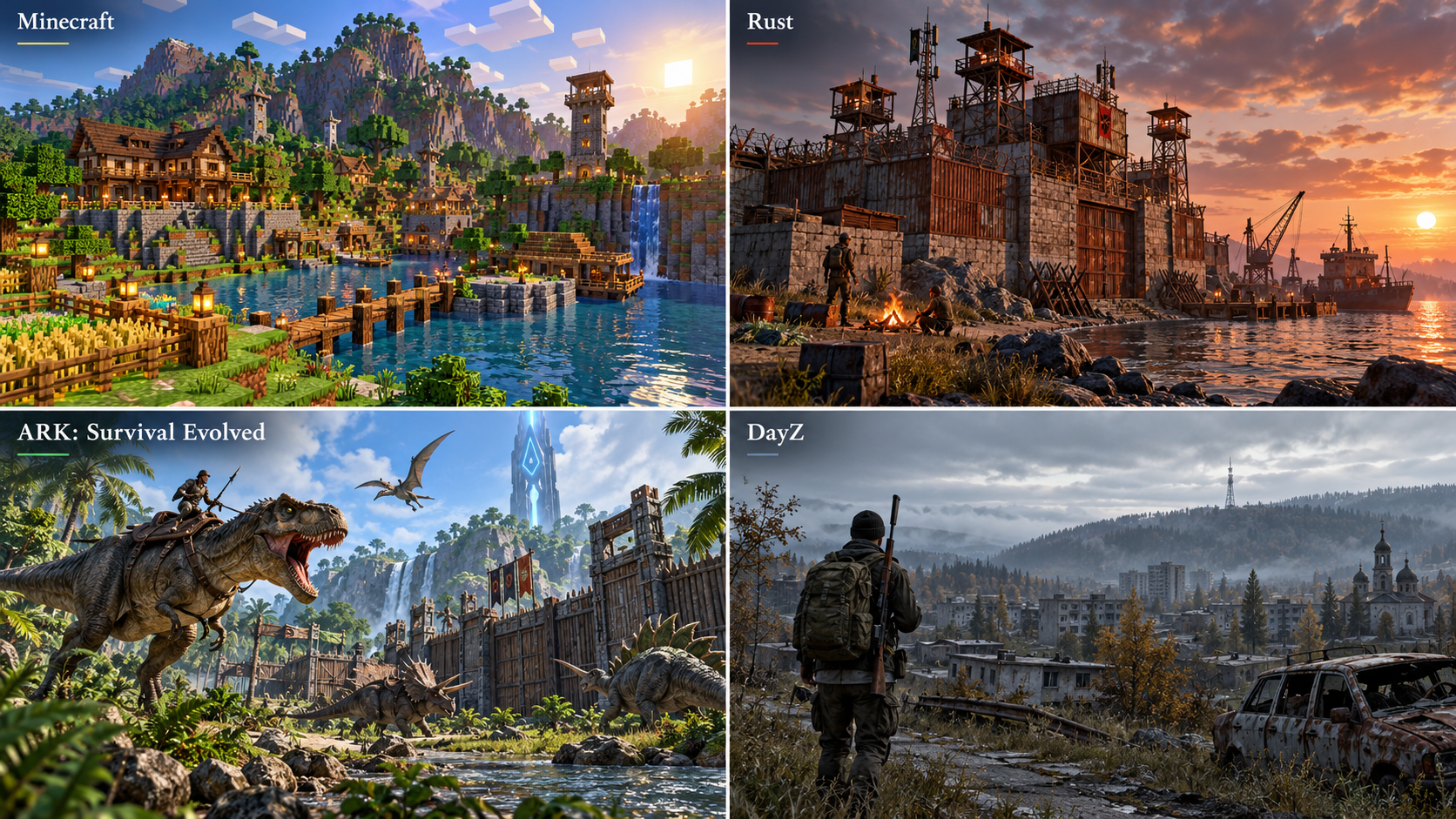
Rust presents another kind of challenge. Server owners may care about map size, wipe schedules, plugin configuration, community population, and maintaining responsive gameplay during busy periods. Host Havoc offers Rust hosting with configurable player slots and integrated support for compatible uMod/Oxide plugins, alongside access to server files and administration tools.
ARK administrators often have additional considerations involving creature populations, save files, mods, and resource-heavy worlds. Meanwhile, a smaller Project Zomboid or Valheim group might prioritize accessible configuration and dependable world persistence rather than building a large public community.
The important lesson is that choosing a hosting provider should begin with the game and the community, not an advertised hardware specification. A package that works comfortably for a few friends may be inappropriate for a large modded environment, even if both are marketed as high-performance hosting.
Host Havoc's extensive game-specific catalog is useful precisely because it gives customers a starting point that reflects these differences. Buyers should still verify the exact game version, mod requirements, supported player count, and configuration options before ordering.
Every game hosting provider talks about performance, but smooth gameplay is the result of several systems working together. A powerful processor cannot compensate for every networking problem, and a fast connection cannot fix a game server overwhelmed by poorly optimized modifications.
Host Havoc advertises infrastructure incorporating Intel Xeon and AMD Ryzen processors, NVMe SSD storage, and DDoS protection. Its Rust hosting page also describes DDR4 and DDR5 memory configurations and network uplinks of up to 10Gbps. These are meaningful infrastructure characteristics, although exact hardware and resource availability depend on the service and region.
For games involving world simulation, artificial intelligence, physics calculations, and many interacting entities, processor performance can be particularly important. Fast storage can help with file operations and world data, while sufficient memory gives the server room to handle its workload without excessive resource pressure.
Yet players often use the word "lag" to describe several unrelated problems. High network latency creates delays between a player and the server. Server-side performance degradation can occur when the game simulation struggles to process everything happening in the world. Client-side frame drops are another issue entirely and may have little to do with the hosting provider.
Server location is therefore one of the most important purchasing decisions. Host Havoc advertises 14 datacenter locations, spanning North America, Europe, and Asia-Pacific. These include cities such as Chicago, Dallas, Los Angeles, London, Amsterdam, Frankfurt, Singapore, and Sydney.
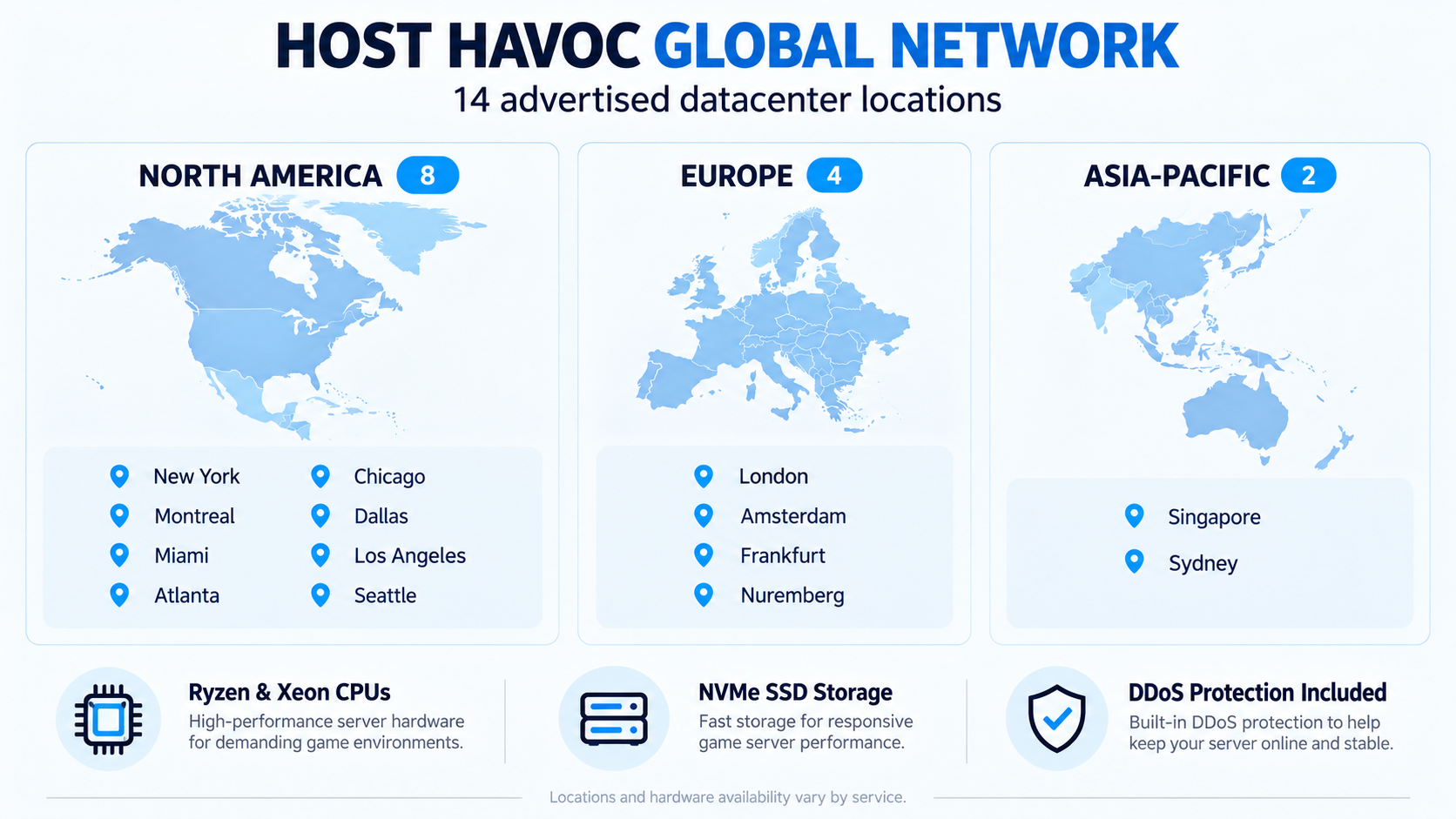
For a group concentrated in Southeast Asia, checking whether Singapore is available for the intended game could be more valuable than selecting a distant server solely because its hardware sounds impressive. Communities with members on different continents may need to compromise on a location that produces acceptable connections for most participants.
Host Havoc also includes DDoS protection in its game hosting proposition. This is especially relevant for public servers, which can attract unwanted network traffic or malicious attacks. Protection reduces certain infrastructure risks but should not be interpreted as a guarantee that every attack or service interruption can be prevented.
It is also important to separate published infrastructure specifications from independently measured performance. Without controlled testing on the exact game, configuration, location, and player load, there is no sound basis for promising a particular ping, tick rate, or uptime result.
Host Havoc offers several encouraging technical foundations. The practical outcome will still depend on choosing appropriate resources, configuring the server carefully, and keeping demanding modifications under control.
A game server can have excellent hardware and still become frustrating if basic administration requires too many complicated steps. For a community owner, the management interface is not a minor convenience. It is the tool used whenever settings change, updates arrive, players encounter problems, or saved data needs attention.
Host Havoc uses a modified TCAdmin v2 game management platform for services such as Rust, while Minecraft has its own dedicated management environment. Because interfaces and available functions can differ by game, prospective customers should review the relevant panel documentation rather than assuming that every title uses exactly the same layout.
For supported game servers, the management tools include a web console, file manager, log viewer, Workshop installer, offsite backups, and data restoration features. These functions address the tasks that commonly occupy a server administrator's time.
The console and logs provide visibility into what the server is doing. File access allows configuration changes and the management of installed content. Backup and restoration options become particularly important before experimenting with plugins, changing major settings, or updating a heavily customized world.
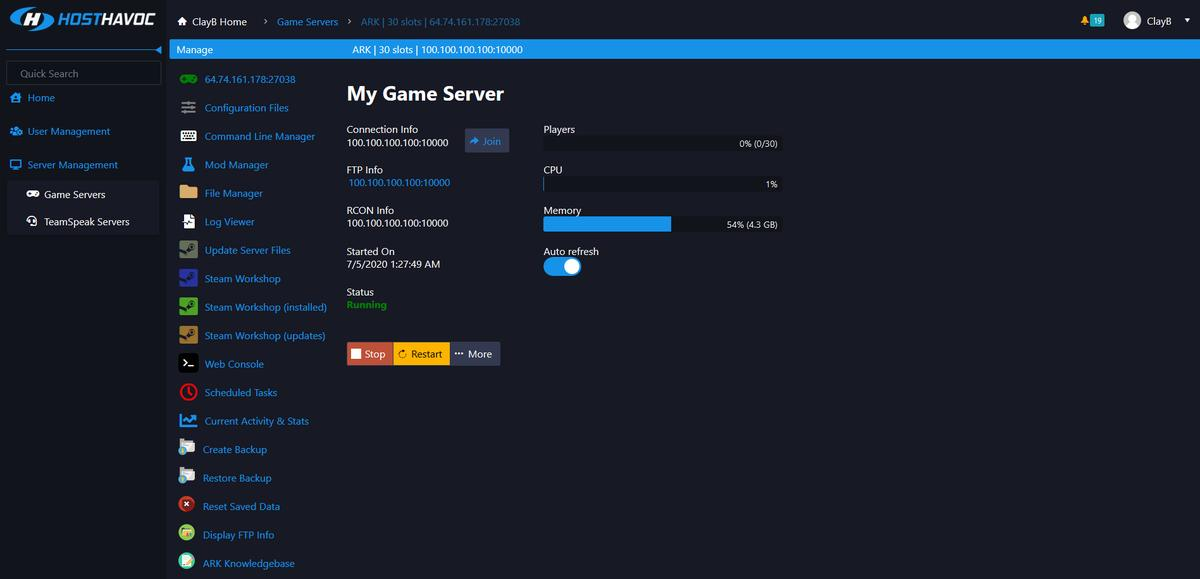
Imagine running a Rust server with a small but active community. You want to adjust gameplay settings, introduce a plugin, restart the server at a convenient time, and investigate an error reported by players. Having those tasks accessible from a centralized interface is considerably more practical than repeatedly interacting with an unmanaged remote machine.
That does not mean server administration becomes effortless. Understanding configuration files, plugin dependencies, and game-specific commands may still be necessary. A friendly interface can simplify access to complicated functions without eliminating the knowledge required to use them properly.
For beginners, the strongest approach is to start with standard settings and introduce modifications gradually. Experienced administrators, meanwhile, may appreciate the combination of convenient panel operations and deeper file access.
The real benefit of Host Havoc's management approach is not that it hides every technical detail. It provides a more organized way to reach the tools that matter, allowing administrators to spend less time navigating infrastructure and more time improving their game worlds.
A private multiplayer server becomes genuinely interesting when its owner can shape the experience. Some communities want a mostly vanilla environment with a few quality-of-life improvements. Others build elaborate modded worlds with custom progression, additional content, new gameplay rules, and unique administrative systems.
Host Havoc supports modding across compatible games, including Steam Workshop content and third-party plugin frameworks where supported. On its Rust hosting page, the company specifically promotes an integrated uMod/Oxide plugin manager, while the broader hosting documentation references support for tools such as ARK API.
These capabilities can make customization more accessible. Installing supported content through an integrated manager is often easier than manually locating files, transferring them into directories, and arranging the configuration from scratch.
However, mod compatibility is ultimately determined by the game, the relevant mod framework, and the specific versions in use. A hosting provider can supply installation tools and access to server files, but it cannot guarantee that every third-party modification will remain compatible after every update.
This distinction becomes particularly important for long-running worlds. Suppose an established ARK or Minecraft community depends on numerous modifications. Installing a new mod may introduce conflicts with existing content, while removing one can affect saved objects or world data. Updating everything simultaneously can make it difficult to identify which change caused a problem.
A safer workflow is to back up the existing world, introduce modifications selectively, and verify that the server starts correctly before inviting the entire community back. For major changes, administrators should also preserve copies of configuration files and confirm that any restored backup works as expected.
Host Havoc's advertised offsite backups and restoration tools are valuable here, but administrators should verify which options are available for their chosen service. Independent copies of important worlds remain sensible, particularly before cancellation or major configuration changes.
Moving an existing world to a hosted server presents similar considerations. File access can support migration, but successful transfers require compatible game versions, appropriate directory structures, and correctly configured modifications. Large or heavily customized worlds may involve more work than starting a fresh server.
For buyers who enjoy shaping a persistent multiplayer community, customization flexibility is one of Host Havoc's most meaningful strengths. The ability to combine practical management tools with deeper access makes the service appealing beyond casual, temporary game sessions.
Technical support often seems unimportant when everything is working. Once a server refuses to start, an update disrupts a modpack, or players discover their saved progress is missing, the quality of support can become more important than a small difference in monthly price.
Host Havoc advertises 24/7 technical support, with average ticket response times of less than 10 minutes. Its billing department is an exception to the round-the-clock availability described in its game hosting FAQ.
The response-time claim is encouraging, but a first reply and a completed resolution are not the same thing. Some problems can be corrected with a configuration adjustment, while others require investigation into game files, third-party plugins, or circumstances beyond the hosting provider's direct control.
Independent customer feedback provides useful context. As checked in October 2026, Host Havoc has a Trustpilot rating of approximately 4.8 out of 5 across more than 1,600 reviews. Many reviewers describe responsive assistance, patient troubleshooting, and helpful guidance during server setup or recovery.
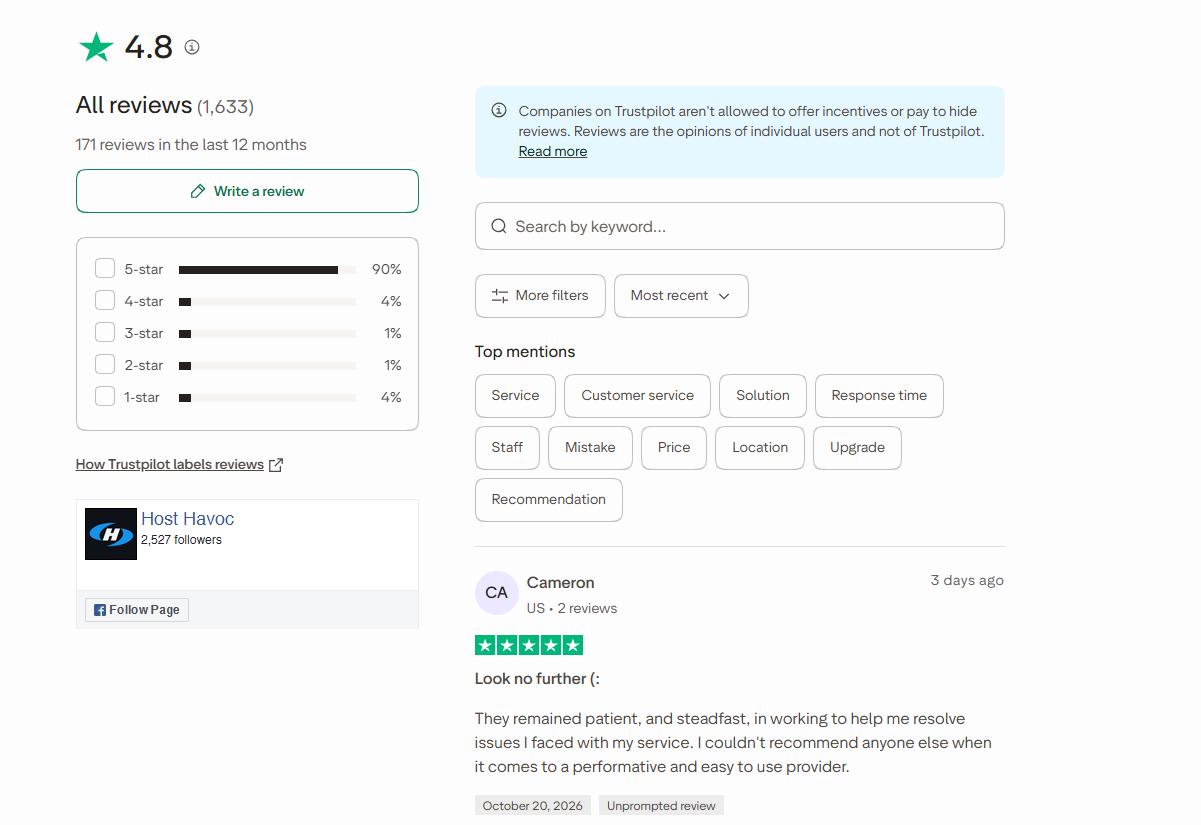
Several recent reviews are especially relevant to game server owners. Customers have described receiving help after configuration mistakes, corrupted world files, and difficulties moving or restoring a server. Such accounts are more informative than vague praise because they concern the problems administrators actually face.
There are also less positive reports involving confusing setup procedures, file-management difficulties, and occasional connectivity concerns. Those experiences deserve consideration, even when the overall review pattern is strongly favorable. Public feedback is self-selected, and an aggregate rating cannot establish performance or support quality for every individual customer.
It is equally important not to treat a successful recovery story as a promise that all lost data can be restored. Recovery depends on what backups remain available and what caused the original problem.
Still, the consistency of positive feedback surrounding technical assistance gives Host Havoc a meaningful advantage in the buying conversation. A server owner is not merely purchasing hardware resources. They are also choosing who they may need to contact when their community is waiting to get back online.
For first-time administrators and busy community managers, access to knowledgeable assistance can be a substantial part of the service's value.
Game server hosting prices can be surprisingly difficult to compare because the number displayed on a product page does not always represent the complete cost of running the environment you want.
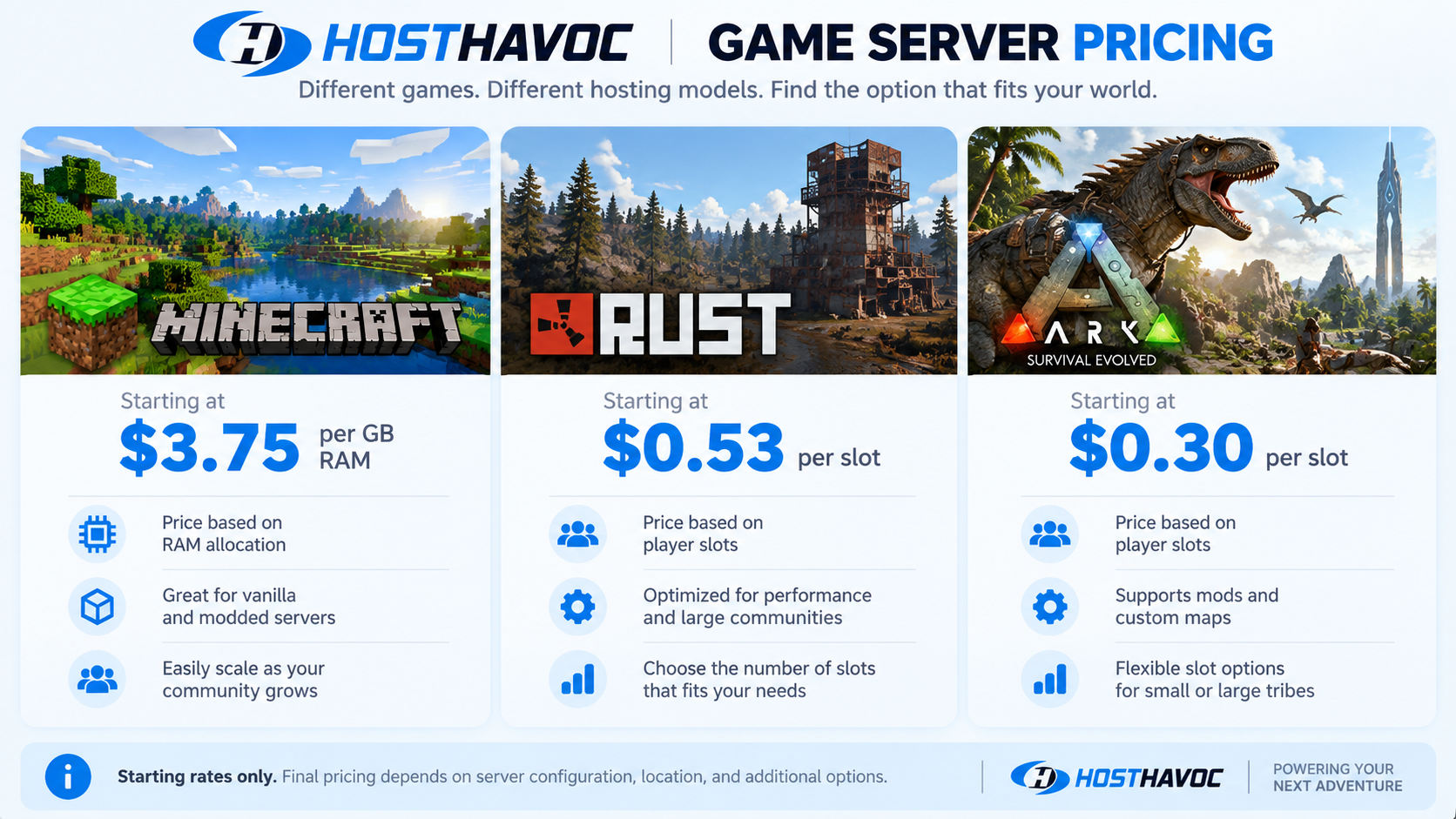
Host Havoc uses different pricing structures depending on the game. Its catalog advertises starting rates such as $3.75 per GB for Minecraft, $0.53 per slot for Rust, and $0.30 per slot for ARK: Survival Evolved. These figures describe starting pricing units, not necessarily the final monthly bill for a usable server configuration.
For example, Host Havoc's Rust ordering page offers a 30-slot selection with a displayed starting total of $16 per month before applicable billing adjustments or extras. In comparison, Minecraft plans are organized around memory allocations, with published options ranging from lightweight vanilla configurations to substantially larger setups.
The difference reflects how customers purchase capacity. Rust buyers must think carefully about their expected community size and available slot packages. Minecraft buyers need to consider memory requirements, particularly when using demanding modpacks or accommodating many simultaneously active players.
For a concrete Minecraft example, the advertised 4 GB plan is $15 per month at the currently displayed promotional rate. If that monthly rate remained unchanged for a full year, the hosting expense would be approximately $180, excluding optional services, applicable taxes, and other adjustments. A 6 GB plan at $22.50 per month would represent approximately $270 over the same period.
These calculations are illustrative rather than guaranteed annual offers. Promotions and pricing may change, and buyers should verify the actual renewal amount during checkout.
Additional features also deserve attention. Host Havoc's Minecraft configuration currently lists a dedicated IP option at $4 per month for eligible plans, while certain higher tiers include it. For customers who do not need a separate dedicated address, that may be an unnecessary expense.
The most economical server is not always the one with the lowest starting price. Underpowered hosting can become frustrating if the community grows or modifications increase resource demand. On the other hand, renting far more capacity than a small group needs can waste money without noticeably improving gameplay.
A better approach is to estimate realistic simultaneous player activity, consider the demands of the intended game and modifications, and leave reasonable room for growth. Then compare the complete monthly cost rather than the advertised per-slot or per-GB figure.
Readers considering the service can explore Host Havoc's available game server plans to compare supported games, server configurations, and current pricing before deciding which package suits their community.
For gaming groups that share an ongoing world, dividing the hosting expense among several members may make the monthly commitment easier to justify. What ultimately matters is whether the cost buys a noticeably simpler and more dependable way to maintain the experience everyone wants.
A private game server often begins modestly. Four or five friends choose a map, invite a few more players, and gradually establish a regular community. As the world develops, its technical requirements may change in ways that were difficult to predict when the original server was ordered.
Growth does not always mean more players. A heavily developed Minecraft world with automated systems, a Rust environment with complex plugins, or an ARK server containing substantial persistent data can become more demanding even if the active population remains relatively stable.
That is why server upgrades should follow measurable needs rather than assumptions. Before purchasing more capacity, administrators should investigate whether performance problems are caused by insufficient resources, problematic modifications, configuration choices, or network conditions.
Host Havoc's game server FAQ states that upgrading a service applies the new configuration while preserving saved data and settings, although the server restarts during the process. This is encouraging for communities that expect to increase their capacity, but keeping an independent backup before major changes is still advisable.
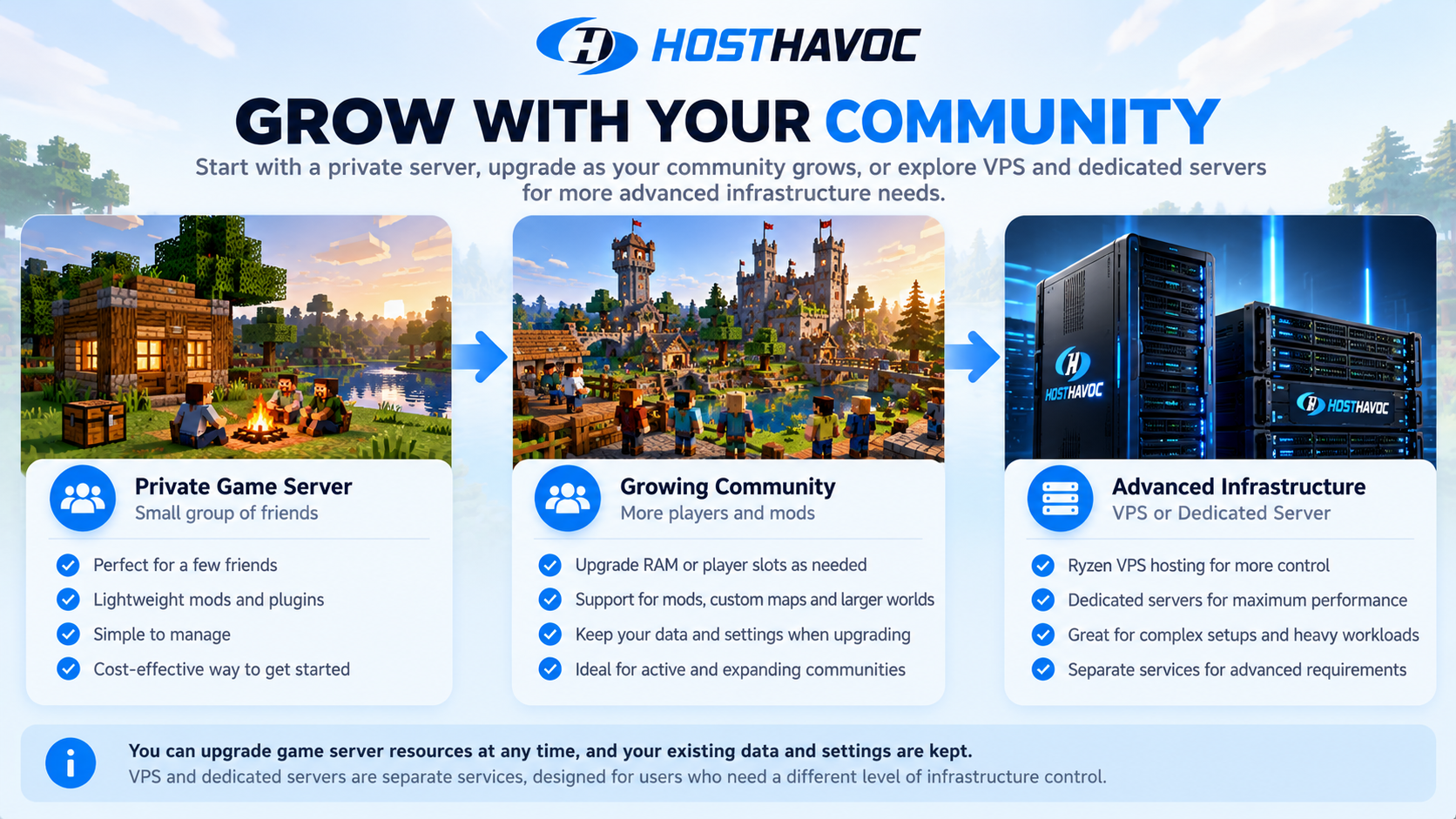
An additional distinction is that Host Havoc offers services beyond conventional game hosting. Its portfolio includes Ryzen VPS hosting and dedicated servers, providing alternatives for customers who eventually need a different level of infrastructure control.
These products should not be confused with ordinary game server upgrades. Managed game hosting provides a more game-focused administration experience, while VPS and dedicated hosting can introduce additional operating-system, security, deployment, and maintenance responsibilities depending on the service.
That additional control may be valuable for experienced users running multiple applications or specialized environments. For a straightforward gaming community, however, moving to more complicated infrastructure simply because it sounds more powerful may offer little practical benefit.
Host Havoc's broader product range is therefore best understood as flexibility rather than an automatic upgrade path. The ordinary game hosting service may remain the most sensible choice for many customers, even as their communities become more established.
The smartest server administrator is not necessarily the one renting the largest machine. It is the one who understands the community's actual workload and chooses an environment that makes those demands manageable.
By this point, Host Havoc presents a persuasive combination of game-specific hosting, capable infrastructure, practical administration tools, and widely appreciated technical assistance. However, a good purchasing decision still depends on understanding what happens after the order is placed.
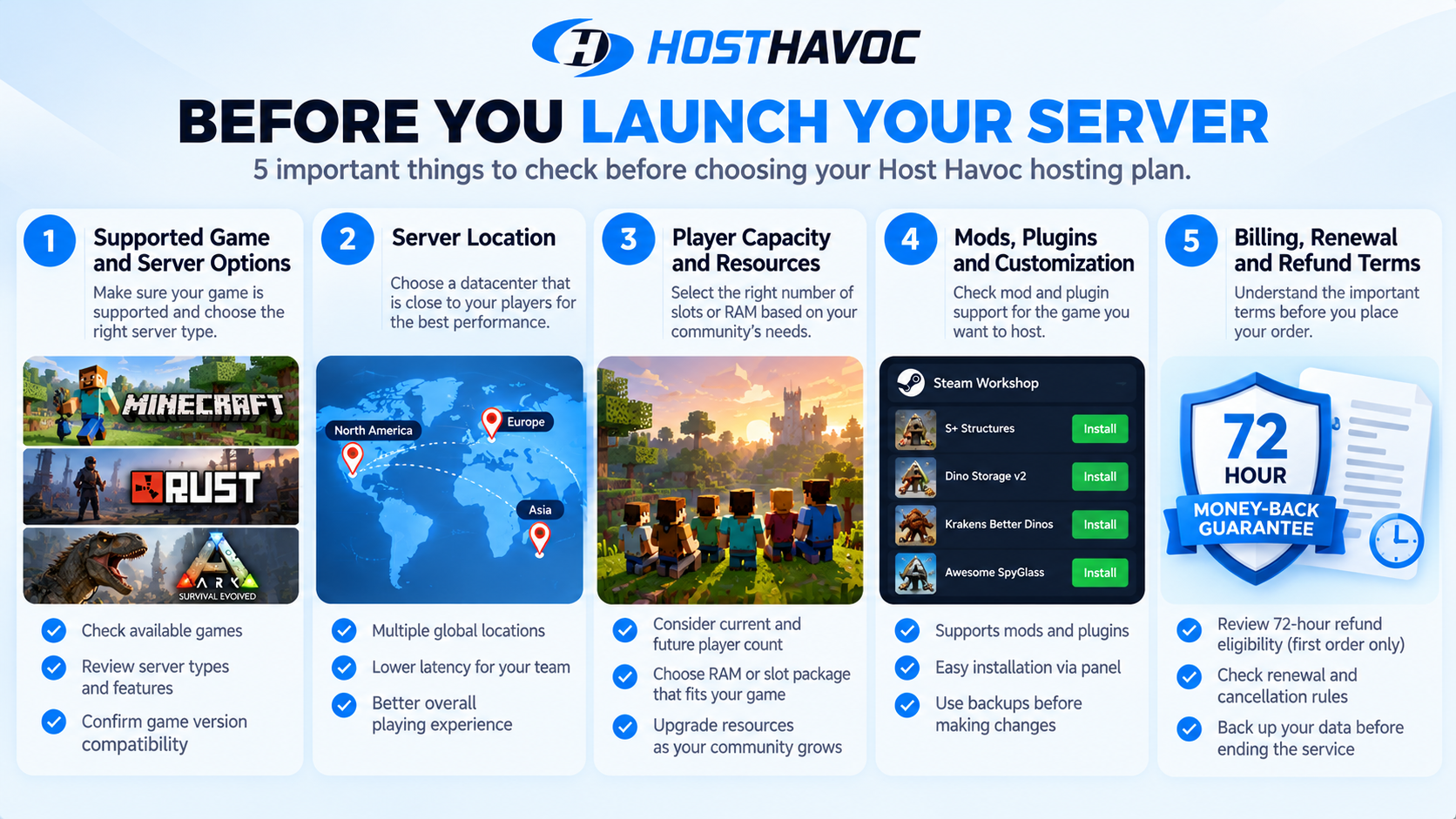
The company's 72-hour money-back guarantee is an important consideration, especially for first-time customers who want to evaluate compatibility and setup. Its formal terms specify that the guarantee applies to an eligible new customer's first hosting order, subject to restrictions. Non-monthly billing terms, product add-ons, and certain other services are excluded, and a refund request must have a qualifying reason.
Refunds are not automatic. Eligible customers must submit a support ticket explaining their request, and the official terms measure the eligibility window from server creation in the company's database rather than necessarily from the moment payment is processed.
This makes a monthly initial purchase worth considering for someone who wants to evaluate the service before committing to a longer billing period.
The cancellation process also deserves attention. Host Havoc's documentation explains that services renew automatically according to the chosen billing interval unless canceled. Customers can request cancellation through the billing area, choosing either immediate termination or cancellation at the end of the current billing period.
That timing matters because immediate cancellation can terminate the service and its data right away. The company's game server FAQ also states that files associated with services that are not renewed are automatically deleted after five days. Exporting important worlds and configuration files before ending a subscription is therefore essential.
These conditions are not reasons to dismiss the service. They are practical details that responsible server owners should understand before entrusting a long-running world to any hosting provider.
So who is Host Havoc best suited for?
It is particularly attractive for groups that want a persistent multiplayer world without maintaining their own hardware, administrators who need accessible tools for managing mods and configurations, and community owners who value being able to contact technical support when problems arise.
Players running heavily customized survival games may also appreciate the range of supported titles and management options, provided they are comfortable investigating occasional compatibility issues.
By contrast, someone hosting a temporary session for two friends might not need a paid dedicated server at all. Technically experienced users who enjoy building and maintaining their own infrastructure may also prefer greater operating-system control from the beginning.
The deciding factor is not whether Host Havoc can make every aspect of multiplayer hosting effortless. No serious provider can honestly promise that. Its appeal lies in making the ongoing responsibility of maintaining a server more approachable, while offering the tools and assistance needed when ordinary gameplay becomes something larger.
A great multiplayer community depends on more than good hardware. It depends on the freedom to shape a world, the confidence that friends can return to it, and the ability to manage problems without letting technical administration overshadow the reason everyone started playing.
Host Havoc brings together a broad selection of supported games, geographically distributed hosting infrastructure, flexible management tools, and a technical support operation that has earned substantial positive customer feedback. For players who want to turn an occasional gaming session into an enduring shared world, that combination is worth considering.
Before ordering, identify the game you want to host, estimate realistic player activity, confirm the closest available datacenter, and compare the complete cost of an appropriately sized plan. Those few decisions will do more for your experience than choosing a server simply because its headline price looks attractive.
You can visit Host Havoc to compare game server hosting options and current plans, review the available configurations, and decide whether its approach to multiplayer hosting fits the world you want to create.
Verdict
Host Havoc is a compelling choice for players and community administrators who want reliable game hosting without taking on the full responsibility of maintaining server infrastructure. Its strongest advantages are the combination of game-specific hosting options, capable management tools, mod support, geographically distributed infrastructure, and a customer support team that receives consistently positive independent feedback. The service is particularly appealing for Minecraft groups, Rust communities, ARK administrators, and survival-game enthusiasts who expect their worlds to remain accessible beyond occasional gaming sessions. However, Host Havoc cannot eliminate the technical challenges of incompatible mods, demanding configurations, or network latency. Buyers should also compare complete plan costs and understand the refund conditions before subscribing. Overall, Host Havoc offers a well-rounded hosting experience where convenience, flexibility, and accessible technical support are just as important as raw server specifications.